Useful information about the Republic of San Marino.
On this page you will be able to find useful information regarding San Marino and its inhabitants, customs and curiosities.
You will be able to learn more directly about the Institutions of the Republic of San Marino: the Judicial Organs, the Council of Sixty, the Captains of the Castle and more!
Find out why April 1 and October 1 of every year is a national holiday in San Marino.
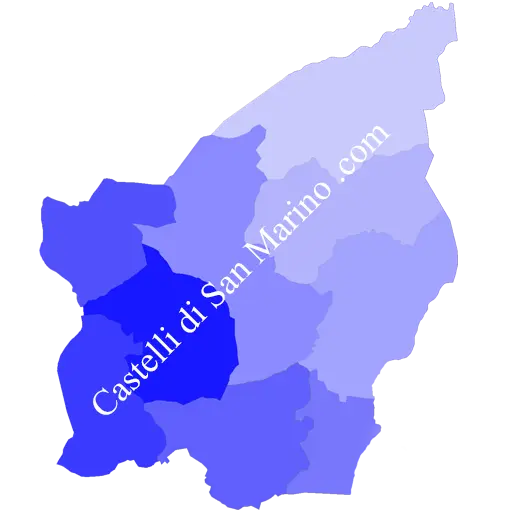
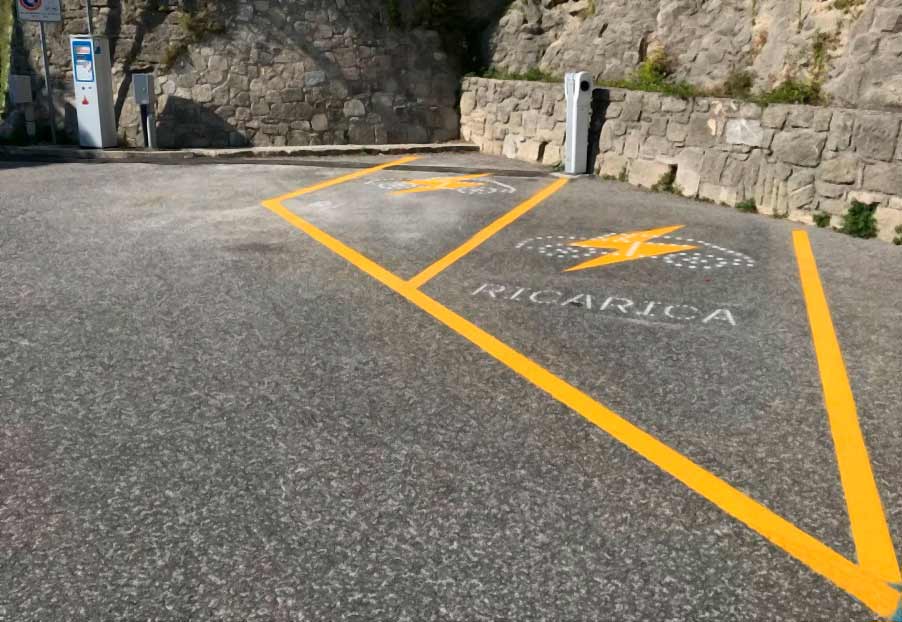
San Marino is not just the oldest Republic in the world: it is also a territory that embraced electric mobility well ahead of the curve. Thanks to the E-Way project, promoted by AASS (the State Autonomous Agency for Public Services), 22 electric-vehicle charging stations and 6 dedicated e-bike charging points are operational across Mount Titano, spread throughout all nine Castelli (districts) of the Republic.
For a territory of just 61 km², the density of charging points is among the highest in Europe relative to surface area and population — a detail that makes San Marino a particularly welcoming destination for those travelling with zero emissions.
How to charge your electric car in San Marino: the ZapGrid app
All charging stations on the E-Way network are managed through the ZapGrid app, available as a free download for Android and iOS. Registration takes just a few minutes and gives access to all the network’s services.
Here is what the app allows you to do:
Geolocation of the nearest charging stations or those in a specific area of interest
Real-time status of each station: available, occupied, in service or out of service
Technical information on power output and connector type
Step-by-step guidance through the charging process via notifications, from unlocking the socket to final release
Integrated payment by credit card or PayPal, directly within the app
Charging history with details on consumption and costs
How to charge your electric car correctly at E-Way stations
The process is straightforward and guided by the app. Here are the steps to charge your electric vehicle at one of the 22 stations across the territory:
Open the ZapGrid app on your smartphone
Select the charging station from the map or scan the QR Code on the socket
If you selected the station from the map, choose the socket you wish to use
Select your preferred charging slot
Start the charge to unlock the socket
Plug the connector into the vehicle first, then into the charging station
When finished, unplug from the station first, then from the vehicle
Complete the session by tapping “Back to Home” in the app
If needed, you can stop the charge at any time using the “Stop charging” button in the app.
Where are the electric-vehicle charging stations in San Marino?
Charging stations are spread across the entire territory of the Republic. Many are located in the main car parks of San Marino, making recharging a seamless part of your visit. Each station is fitted with two sockets rated at 11 kW and 22 kW (AC charging, Type 2).
Here is the full list of E-Way charging stations, organised by district:
San Marino Città
– Via Napoleone Bonaparte (Car park P10) – Beginning of Via Gino Giacomini (Car park P9) – Piazzale Girolamo Genga – Orto del Collegio (Car park P8) – Piazzale Marino Giangi (Coach park P2) — currently suspended — – Viale J.F. Kennedy (near the Kursaal Conference Centre) – Piazzale Cava Antica (Car park P6) – Piazzale Cava degli Umbri (Car park P7)
Borgo Maggiore
– Via Oddone Scarito (in front of the arcades, a few metres from the San Marino Cable Car) – Piazzale Enea Suzzi Valli (car park next to the main entrance of the State Hospital)
Serravalle
– Piazza Bertoldi – Multieventi Sport Domus (both next to the main entrance and in the rear car park)
Domagnano
– Piazzale Vincenzo Terenzi
Acquaviva
– Centro Gualdo car park
Chiesanuova
– Piazzale del Lavatoio
Fiorentino
– Car park at the Fiorentino Community Centre
Montegiardino
– Via del Dragone
Faetano
– Piazza del Massaro
Dogana (Serravalle): – Piazza Enriquez – World Trade Center
Tesla charging in San Marino: the Tesla Destination Charger
At Car park P7 (Piazzale Cava degli Umbri) in San Marino Città there is a Tesla Destination Charger with a Type 2 connector rated at 22 kW. It is an AC slow-charging station (not a Supercharger), open to all electric vehicles fitted with a Type 2 socket and not reserved exclusively for Tesla cars.
It is the only dedicated Tesla charging point on San Marino’s territory. Drivers needing a fast DC charge will find the nearest Tesla Superchargers along the Romagna coast, in Italian territory.
E-bike charging in San Marino
In addition to the car chargers, San Marino offers 6 e-bike charging points located in Piazzale Cava degli Umbri (Car park P7) in San Marino Città. Anyone riding the Cammino del Titano trail or exploring the territory by e-bike can count on this central and easily accessible charging point.
Practical tips for EV charging in San Marino
If you are planning a visit to San Marino in an electric vehicle, you can tackle the climb up Mount Titano with confidence. The charging stations in the main car parks — P6, P7, P8, P9 and P10 — allow you to recharge comfortably while exploring the Old Town, visiting the Towers, the Palazzo Pubblico or shopping. The average charging time at 22 kW provides enough range to be recovered during a 3–4 hour visit.
We recommend downloading and setting up the ZapGrid app before departure, checking station availability in real time to avoid waiting. Charging is paid and the cost is calculated per kWh consumed.
For information on the E-Way service, visit the official AASS website or download the ZapGrid app from zapgrid.net.
https://www.castellidisanmarino.com/wp-content/uploads/2020/04/Stazione-ricarica-auto-elettriche-san-marino-colonnine.jpg622902Castelli di San Marinohttps://www.castellidisanmarino.com/wp-content/uploads/2017/04/cropped-Castelli-di-San-Marino-Favicon.pngCastelli di San Marino2026-05-14 09:38:492026-05-14 09:52:58Electric vehicle charging in San Marino: stations, map and complete guide
Obtaining residency in San Marino is like climbing a mountain: it requires preparation, resources, and an expert guide. But once at the top, the panorama – in this case made of tax advantages and quality of life – repays every effort.
Why move to San Marino?
Nestled in the heart of Italy, the Republic of San Marino represents an oasis of 61 km² with just 33,000 inhabitants. The oldest independent state in the world, it offers a perfect balance between millennial history and modernity. In recent years, more and more people choose to move here, attracted by an advantageous tax system, high standards of security, and quality of life.
“After years in the city, finding here a serene environment with all the advantages of an efficient system has changed my professional and personal life” – We don’t publish the name for privacy.
Attention: The number of new residencies granted each year is limited and varies according to government provisions. For 2024, available spots are rapidly decreasing!
How to obtain residency in San Marino: all available options
San Marino offers several possibilities to obtain residency, each designed to respond to specific needs. Let’s see together which could be the most suitable for your case:
1. Registry residency
The most traditional form of residency, granted to:
Spouses of San Marino citizens
Children of San Marino citizens
Holders of ordinary residence permits for at least 5 continuous years
Professionals in top roles in the healthcare, banking, or security sectors
2. Elective residency
Dedicated to investors, requires:
Real estate investment minimum of €500,000 for own or family housing
Or ten-year restricted deposit of €600,000 in government securities
One-time tax of €10,000
Administrative cost of the application: €1,000
3. Residency for economic reasons
For entrepreneurs who hold at least 51% of a San Marino company:
Need to hire employees from employment lists
Guarantee deposit of €75,000 (first two years)
Increase to €150,000 after the initial two years
4. Atypical residency with facilitated tax regime
For those who produce income abroad:
Facilitated taxation at 7% on income
Minimum annual tax: €10,000
Maximum annual tax: €100,000
5. Residency for pensioners
Particularly advantageous for those who receive pensions from abroad:
Reduced taxation at 6% on pensions
Requirement: annual income over €50,000 or movable assets not less than €300,000
How much does it cost to live and obtain residency in San Marino?
Costs vary significantly depending on the type of residency chosen:
Basic administrative costs
These should be budgeted for all types of residencies.
State fee for application processing: €1,000*
Mandatory health insurance (minimum coverage €30,000)
Required investments
Elective residency: €500,000 (property) or €600,000 (deposit)
Economic residency: €75,000-150,000 (guarantee)
Atypical residency: No minimum investment but demonstrable foreign income
Cost of living
The cost of living in San Marino is comparable to that of the neighboring Italian regions such as Emilia-Romagna and Marche, with some advantages:
Reduced prices for fuels
Absence of VAT (replaced by single-phase tax)
Competitive rates for essential services
Checklist: what you need to move to San Marino
✅ Fundamental requirements
No pending criminal proceedings
Availability of suitable accommodation
Adequate means of support
Private health insurance (first years*)
✅ Necessary documentation
Valid identity document
Current residence certificate
Criminal certificate from the country of origin
Income/asset documentation
Health insurance policy
✅ Timeframes to consider
Documentation preparation: 1-2 months
Application evaluation: 60 days
Completion of requirements: variable based on type
How to become a citizen of San Marino?
The path to San Marino citizenship is regulated by Law no. 114/2000:
Time requirements
15 years of continuous residency for ordinary naturalization
10 years for residency consolidation
Reduced period for spouses of San Marino citizens
Additional conditions
Renunciation of original citizenship (if required)
Passing Italian language test
Knowledge of San Marino history and culture
The main advantages of residency in San Marino
Tax advantages
Facilitated taxation for specific categories
Favorable tax regime for businesses (17% ordinary, 8.5% facilitated)
Absence of VAT (replaced by single-phase tax)
Real estate capital gains exempt after 5 years
Taxation at 3% on foreign dividends
Quality of life
Efficient healthcare system
Security and political stability (almost no crime)
Strategic position in the heart of Italy
Excellent educational system
Preserved natural environment
The step-by-step process
Preliminary analysis of personal/financial situation
Choice of the type of residency most suitable
Collection of necessary documentation
Submission of the application
Evaluation by the Congress of State (60 days)
In case of approval, completion of specific requirements
Registration in the residents register
Consolidation period (10 years)
Frequently asked questions about residency in San Marino
Is it possible to work as a public employee with elective residency?
No, until the consolidation of residency (10 years), holders of elective residency cannot access employment relationships in the Expanded Public Sector.
Can I extend residency to family members?
Yes, most types of residency can be extended to spouse and children, sometimes with the payment of additional taxes.
Does residency in San Marino entail the loss of original citizenship?
No, obtaining residency does not imply renouncing original citizenship. Only the eventual request for San Marino citizenship (after 15 years) might require it.
Is it necessary to physically reside in San Marino?
Yes, an effective presence is required, even if not continuous. Authorities can verify the actual presence on the territory.
What are the response times for the residency application?
The Congress of State deliberates within 60 days from the submission of the complete application.
Conclusions: is it the right time to move?
Obtaining residency in San Marino represents a significant opportunity for those seeking tax advantages, quality of life, and stability. However, it requires careful planning and, often, the support of qualified professionals.
Don’t wait for the available spots for 2025 to run out! The time to start your journey towards San Marino residency is now.
The choice of the most suitable path depends on several factors:
Economic availability
Personal or business objectives
Desired timeframes
Family situation
To explore specific aspects of residency in San Marino, consult our dedicated guides:
To safely navigate the path towards San Marino residency, we recommend consulting specialized professionals. A qualified consulting firm can:
Analyze your personal and fiscal situation
Identify the path best suited to your needs
Assist in the preparation of documentation
Follow the entire administrative process
Provide you with updates on regulatory changes
Last update: February 2025
https://www.castellidisanmarino.com/wp-content/uploads/2025/02/San-Marino-residency.jpg11791766Castelli di San Marinohttps://www.castellidisanmarino.com/wp-content/uploads/2017/04/cropped-Castelli-di-San-Marino-Favicon.pngCastelli di San Marino2026-03-07 20:38:202026-01-17 15:53:06San Marino Residency: Complete Guide
Anyone who suffers from celiac disease, like me, knows that feeling well: the desire to enjoy a dinner out without having to consult dozens of websites, make phone calls in advance, or worse still, give up altogether. San Marino, the world’s oldest republic, has decided to become one of the most welcoming destinations for those seeking quality gluten-free restaurants.
Visiting San Marino City means immersing yourself in a breathtaking medieval village, with its three iconic towers dominating Mount Titano. But for a celiac, it also means being able to count on a network of prepared, certified venues ready to transform lunch or dinner into a moment of pure gastronomic pleasure.
In this guide, you will find all the restaurants, pizzerias and bistros where you can eat gluten-free in San Marino and surroundings, with practical information on certifications, menus and booking tips. Please note, only certified gluten-free restaurants have been included; with proper precautions and advance notice, it is also possible to have lunch or dinner at other non-certified restaurants.
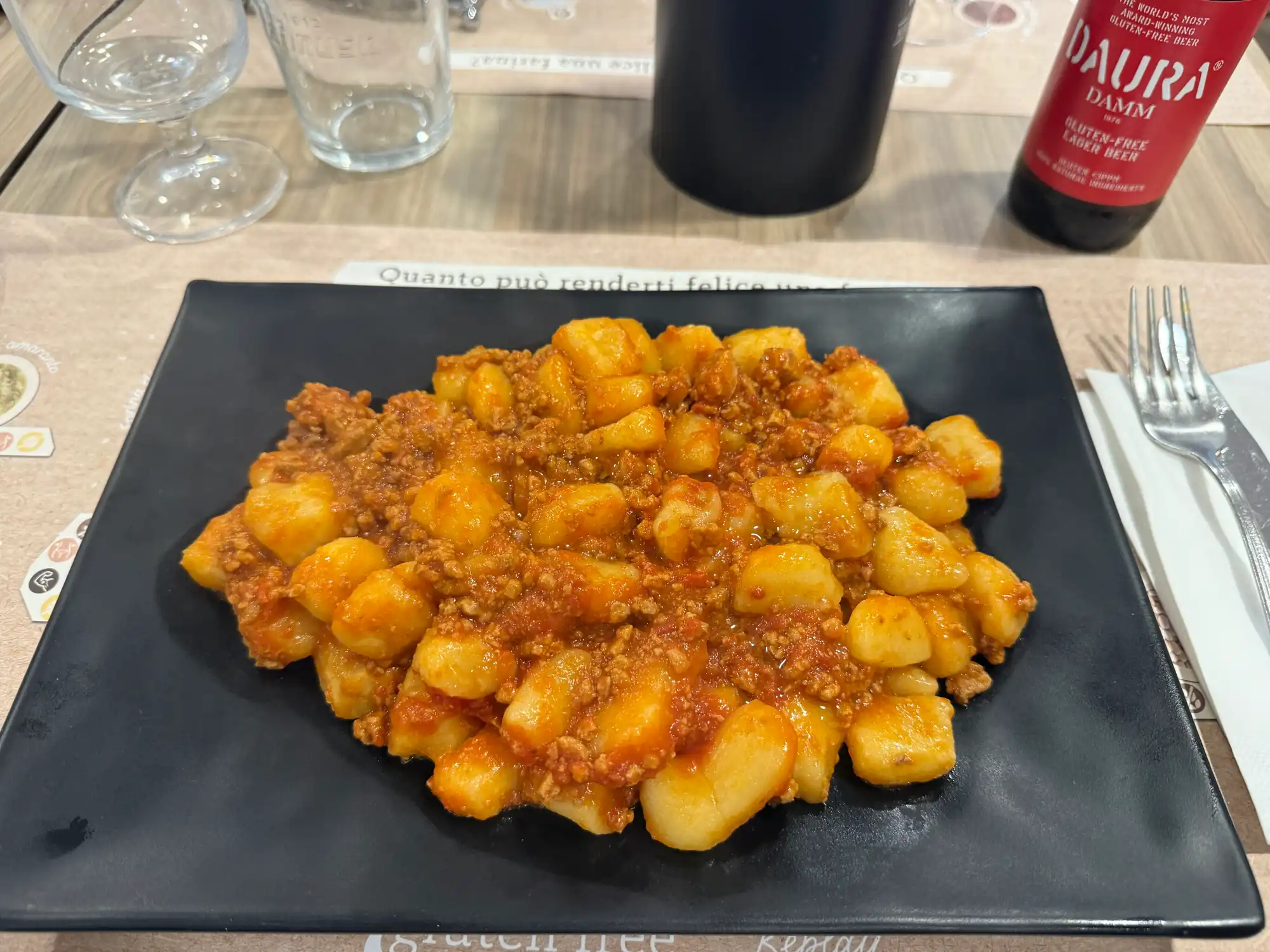
Gluten-free gnocchi with ragù made at Replay gluten-free bistrot in San Marino
Why Choose a Certified Gluten-Free Restaurant in San Marino
The difference between a restaurant that “offers gluten-free options” and one certified by AIC (Italian Celiac Association) is not just semantic: it’s a matter of food safety. Venues participating in the AFC (Eating Out) programme follow rigorous protocols ranging from staff training to ingredient management, through to cooking and plating procedures.
San Marino is part of the AFC network of AIC Emilia Romagna, which has over 200 certified venues across the region and the small Republic. This means regular inspections, constant updates on regulations and the certainty of finding trained staff who are aware of the needs of those living with celiac disease.
How to Recognise a Certified Restaurant and What It Means for Food Safety
An AIC certified venue displays the official AFC programme window sticker, but the advice is always to verify actual membership through the AIC Mobile app or the official Italian Celiac Association website. Certification guarantees the use of products listed in the National Register of Gluten-Free Foods of the Ministry of Health and the application of specific procedures to avoid any cross-contamination.
In addition to AIC certified venues, there are restaurants that, while not formally participating in the programme, have developed specific expertise in gluten-free cooking, trained staff and years of experience serving celiac customers. In this guide, you will find them all, with clear indications of their level of preparation.
The Role of the AFC Network in Protecting Celiacs
The AIC’s Eating Out programme does not just issue certifications: it offers ongoing training to restaurateurs, up-to-date informational materials and a system of checks that ensures standards are maintained over time. For those travelling or visiting San Marino during a day of discovery, knowing you can count on this network means freedom of choice and peace of mind.
Gluten-Free Restaurants in San Marino’s Historic Centre
San Marino’s historic centre offers some of the best options for eating gluten-free, with venues that combine Romagna culinary tradition with attention to the needs of celiac customers.
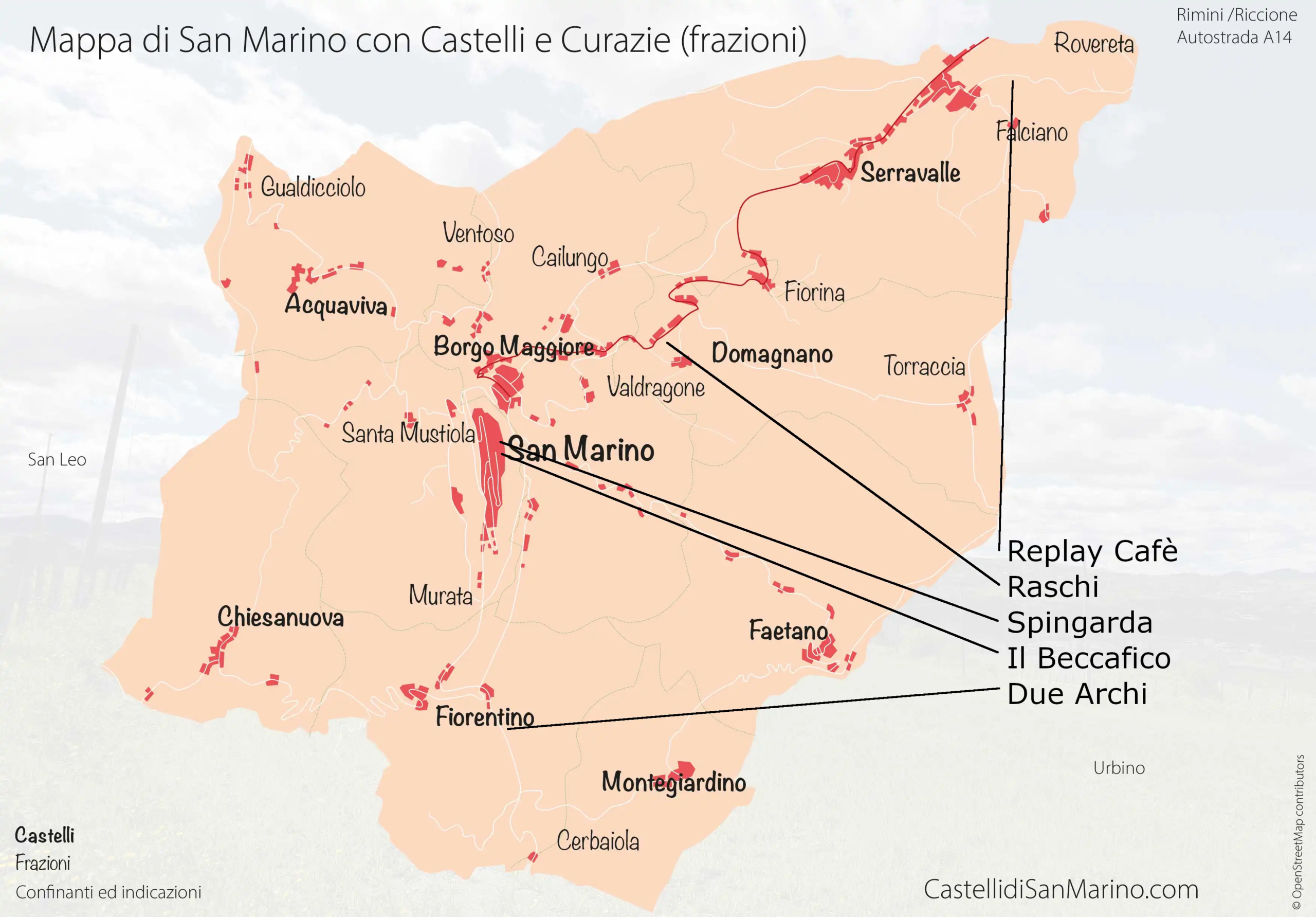
Ristorante Pizzeria Il Beccafico
Address: Via Salita alla Rocca 35, 47890 City of San Marino Phone: 0549 992430 Certification: AIC circuit member
Located along the road leading to the First Tower Guaita, Il Beccafico has become a reference point for those seeking quality gluten-free cuisine in San Marino. The venue is part of the AIC circuit and offers a menu where it is clearly specified whether a product is gluten-free or not.
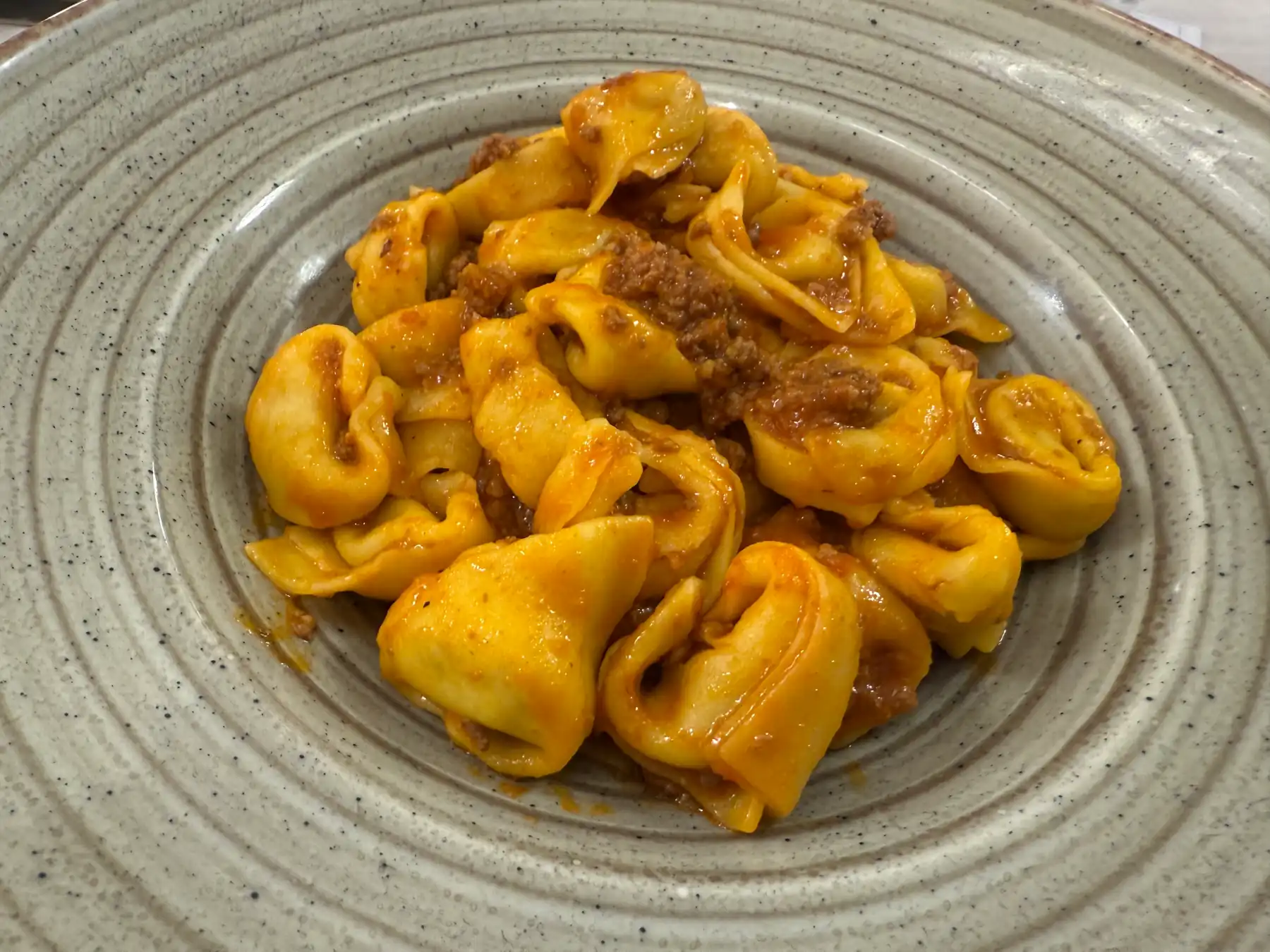
Generous plate of tortellini with ragù eaten at the Beccafico restaurant
The kitchen offers homemade fresh gluten-free pasta, from tagliatelle to tortellini, from ravioli to strozzapreti, all prepared in the internal workshop. The pizza, made with their own dough rather than ready-made bases, represents another excellence of the venue. The panoramic terrace with views over the Valmarecchia valley makes the experience even more memorable.
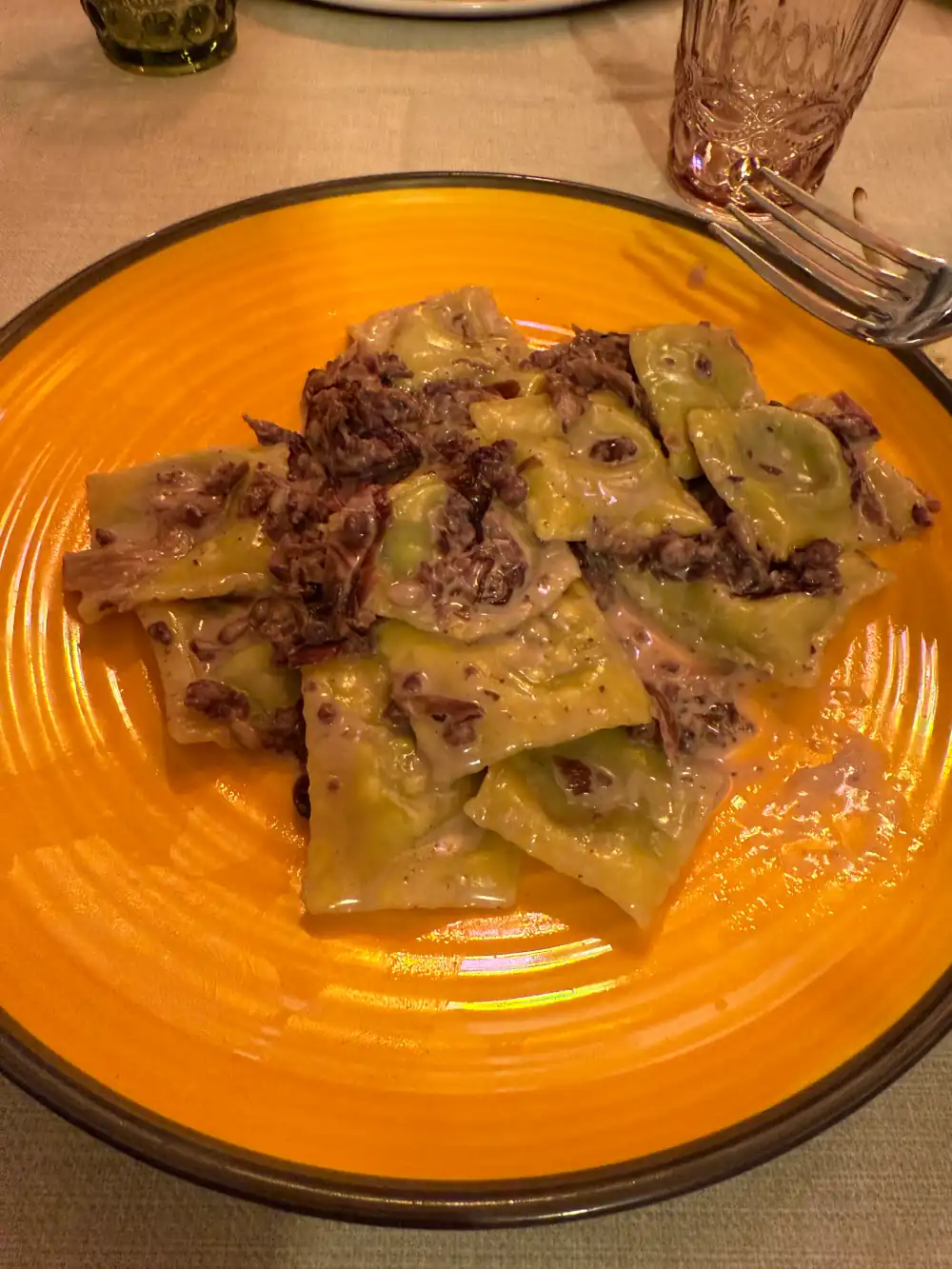
Gluten-free ravioli from Il Beccafico restaurant in San Marino City
Celiac customers particularly appreciate the attention to detail and the competence of the staff, who perfectly understand the needs of those who must avoid gluten.
Ristorante Pizzeria Spingarda
Address: Contrada dei Magazzeni 30, 47890 City of San Marino Phone: 0549 992306 Certification: AIC circuit member
Another historic venue in the centre, Spingarda is certified by the Italian Celiac Association and offers an extensive gluten-free menu ranging from starters to desserts. The gluten-free pizza is particularly appreciated.
Among the specialties to try: seafood dishes are definitely the stars. The veranda with panoramic views over the surrounding hills is the ideal place for a romantic dinner or a special evening. The staff is trained and attentive, and the restaurant can also host private events for those wishing to celebrate special occasions with entirely gluten-free menus.
Gluten-Free Restaurants Outside the Historic Centre
Those who prefer to venture off the most beaten tourist paths or are looking for options in the various Castles of the Republic will find other valid choices.
Ristorante Pizzeria Due Archi – Fiorentino
Address: Via del Passetto 47, 47897 Fiorentino Phone: 0549 997889 Certification: AIC circuit member
Located in the Castle of Fiorentino, Due Archi is a restaurant and pizzeria that is part of the AIC circuit. Perfect for families, it offers a complete menu with gluten-free options ranging from traditional cuisine to pizza.
The atmosphere is welcoming and informal, ideal for a family lunch or a quiet dinner away from the crowds of the historic centre.
Ristorante Pizzeria Raschi – Domagnano
Address: Strada XXV Marzo 13, 47895 Domagnano Phone: 0549 963721 Certification: AIC circuit member
In the Castle of Domagnano, Raschi is another AIC certified venue worth visiting. The atmosphere is refined and aesthetically pleasing, with tables both indoors and outdoors (during summer). The kitchen offers fresh, traditional products, with particular attention to gluten-free pizza and first courses.
Gluten Free Bistrot – Replay Cafè – Falciano
Address: Via dei Paceri 84/c, 47891 Falciano Phone: 0549 909986 Certification: 100% gluten-free AIC certified venue
Replay Cafè represents an exception in the gluten-free dining landscape: it is a venue with a dual kitchen, with a space entirely dedicated to gluten-free cooking, featuring an open workshop where sweet and savoury products are prepared fresh every day.
Perfect for breakfast with croissants, cream puffs and fresh pastries, Replay also offers lunches with homemade fresh pasta, pizza by the slice and main courses. The atmosphere is modern and welcoming, the owners always greet you with a smile and their expertise on celiac disease is complete.
Important to know: the venue is mainly open during the week (Monday to Friday for lunch, closed on Sundays), making it ideal for those working in the area or for a break during a trip to San Marino. They also offer takeaway service, excellent for those who want to stock up on quality gluten-free products.
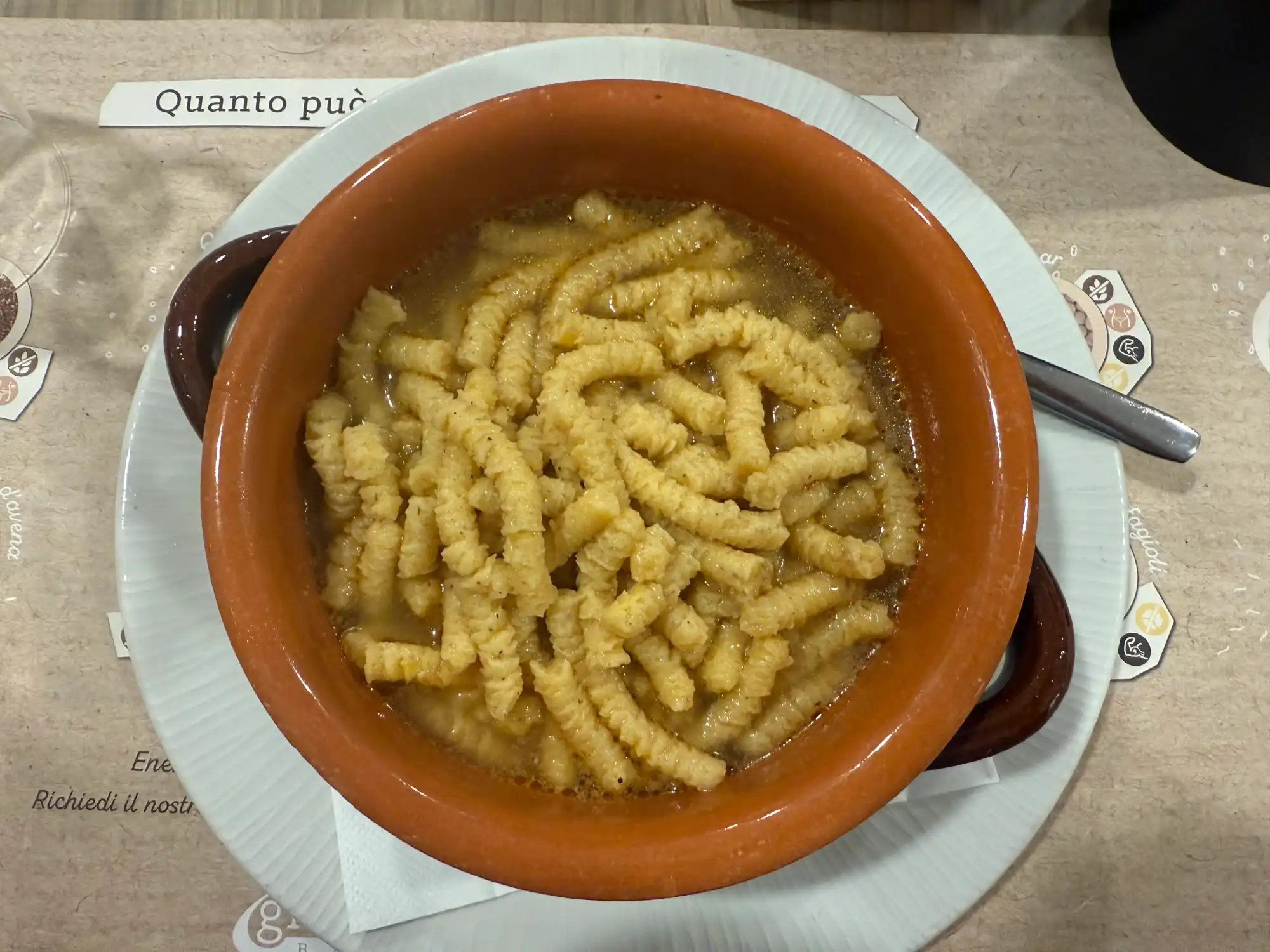
Gluten-free passatelli from Replay
Just Outside the Border: A Historic Option
For those arriving in San Marino from the Romagna coast, there is a historic venue that deserves special mention.
Pizz’Osteria Da Mazza – Cerasolo di Coriano
Address: Via Ausa 138, Cerasolo di Coriano 47853 Phone: 0541 759060 Certification: AIC circuit member since 2011 – Historic Shop
On the consular road from Rimini to San Marino, the Mazza family has been running this venue since 1963, obtaining AIC certification for gluten-free dining in 2011. It has become a true reference point for celiacs throughout the province of Rimini and for tourists visiting San Marino.
The special feature? The entire menu is available in a gluten-free version, from Romagna piadina to homemade pasta, from pizza to fried fish. They have two separate kitchens to ensure maximum safety.
The venue has received the Historic Shop recognition from the Municipality of Coriano, testament to over 60 years of business and tradition.
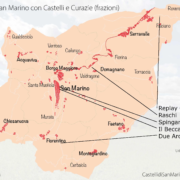
Map of San Marino showing where to find gluten-free restaurants
Contamination Prevention: What to Expect
Food safety is the main concern of every celiac when eating out. Here’s what certified restaurants do to ensure a safe meal.
Kitchen Safety Protocols
Venues belonging to the AIC circuit follow codified procedures that include separation of preparation areas, use of dedicated utensils (pots, ladles, cutting boards), thorough cleaning of surfaces before preparing gluten-free dishes and separate storage of ingredients.
In more structured venues, such as Replay Cafè in Falciano or Pizz’Osteria Da Mazza, there are completely separate kitchens, which represent the highest possible level of safety.
Staff Training
Staff at certified venues participate in specific training courses on celiac disease and gluten-free food preparation procedures. This means that waiters and chefs understand the risks of cross-contamination and know how to handle requests from celiac customers.
When booking, always specify your requirements: a well-prepared venue will appreciate advance communication and can guarantee you better service.
How to Book and Communicate Your Needs
A well-managed booking is the first step towards a relaxed experience. Here are some practical tips.
Booking Channels
All listed venues accept phone bookings. Some, like Il Beccafico and Spingarda, can also be reached through their websites and social media pages. When booking, clearly communicate that you are celiac and need a gluten-free menu.
What to Communicate
Specify if you only have celiac disease or also other intolerances (lactose, nickel, etc.), so the kitchen can prepare adequately. If travelling with a mixed group (celiacs and non-celiacs), enquire about the possibility of having different menus at the same table.
Waiting Times
Freshly prepared gluten-free dishes may require longer times, especially for fresh pasta and pizza dough. Consider this when planning your visit, particularly if you have time constraints during a tourist itinerary.
Gluten-Free Menu: From Starter to Dessert
Gluten-free cuisine in San Marino doesn’t mean sacrifices, but rather discovering authentic flavours prepared with quality ingredients.
Starters and First Courses
Romagna tradition naturally offers many gluten-free dishes: local cured meats and cheeses, grilled vegetables, fish carpaccio. For first courses, certified restaurants offer homemade fresh pasta such as tagliatelle, cappelletti, tortellini and strozzapreti, all prepared with gluten-free flours.
The piadina, symbol of local tradition, is available in a gluten-free version at several venues, particularly at Pizz’Osteria Da Mazza.
Main Courses and Desserts
Meat and fish main courses are generally safe, but watch out for breadings and sauces. Certified venues also know how to prepare gluten-free fried foods using dedicated oil and certified flours. For desserts, from classic almond cake to more elaborate gluten-free tiramisu, options are plentiful.
Summary Table of Gluten-Free Restaurants
Venue
Area
AIC Certification
Specialties
Contact
Il Beccafico
Historic centre
✓
Fresh pasta, meat dishes, pizza
0549 992430
Spingarda
Historic centre
✓
Seafood starters and mains, pizza
0549 992306
Due Archi
Fiorentino
✓
Traditional cuisine, pizza
0549 997889
Raschi
Domagnano
✓
Pizza, pasta
0549 963721
Replay Cafè
Falciano
✓
Breakfast, lunch, takeaway
0549 909986
Da Mazza
Cerasolo (RN)
✓
Piadina, seafood, pizza
0541 759060
FAQ: Frequently Asked Questions About Gluten-Free in San Marino
Do I need to book in advance?
Yes, it is always recommended to book while communicating your dietary requirements, especially on weekends and during peak tourist season.
Are AIC certified venues more expensive?
Prices are generally in line with traditional restaurants. Some venues apply a small surcharge for gluten-free dishes due to the higher cost of ingredients.
Can I trust non-certified venues?
AIC certification is the most reliable guarantee. For non-certified venues, the advice is always to clearly communicate your needs and assess the staff’s knowledge.
Are there gluten-free ice cream shops in San Marino?
Some ice cream shops, like Sweet Line in San Marino Dogana, as well as other gelaterias, offer gluten-free products, although they are not certified and cannot guarantee against cross-contamination.
How do I verify if a venue is truly AIC certified?
Through the AIC Mobile app or the official Italian Celiac Association website. The lists of member venues are reserved for AIC members.
Experiencing San Marino Gluten-Free: A Complete Experience
San Marino is not just towers, panoramas and millennial history. For those living with celiac disease, it is also proof that travelling and eating well are rights that should not be denied by a food intolerance.
The restaurants and pizzerias of the Republic today offer conscious, prepared hospitality that is genuinely attentive to the needs of celiacs. Whether you’re planning a day trip or a longer stay, knowing you can count on safe venues makes the experience infinitely more enjoyable.
Have a great trip and bon appétit – gluten-free, of course.
https://www.castellidisanmarino.com/wp-content/uploads/2026/01/cartina_san_marino_senza_glutine_2026-scaled.webp17832560Castelli di San Marinohttps://www.castellidisanmarino.com/wp-content/uploads/2017/04/cropped-Castelli-di-San-Marino-Favicon.pngCastelli di San Marino2026-01-21 20:54:542026-01-22 10:04:39Gluten-Free Restaurants in San Marino
As twilight envelops the nine castles of the Republic on March 18th, San Marino transforms into an archipelago of dancing lights. Like fire sentinels, the “focheracce” (traditional bonfires) ignite one after another, illuminating the most magical night of the year: the one dedicated to fathers and traditions that, like embers, are passed down from generation to generation.
The Fire Ritual That Unites Communities
In San Marino City, flames rise majestically in the P10 parking lot and in the Casole area. Nearby, in Borgo Maggiore, the school parking lot transforms into a theater of sparks and warmth, while in Serravalle the Ausa Park welcomes entire families around its ritual fire.
Each castle jealously guards its own bonfire, different in form but identical in essence: a moment when time slows down, adults chat while managing the flames, and children run and play, immersed in the freedom that only village festivals can offer.
A Heritage of Shared Emotions
It’s not just the steaming “piadina” flatbreads stuffed with sausage that warm the atmosphere, nor the music that accompanies the evening. It’s something deeper: that sense of belonging that only small communities can cultivate, an invisible bond that envelops residents and visitors alike, as the smoke from the bonfires disperses into the air of the world’s oldest Republic.
In these brief hours, San Marino rediscovers its most authentic soul: not that of historical monuments or famous towers, but that of spontaneous encounters, sincere laughter, and the simplicity that is the true luxury of those who still appreciate traditions.
Visiting San Marino during Father’s Day means immersing yourself in an experience that goes beyond simple tourism: it means becoming, even if just for one evening, part of an extended family that celebrates fathers and, with them, the cultural heritage of a truly unique territory.
https://www.castellidisanmarino.com/wp-content/uploads/2025/03/fogheraccia-a-san-marino-citta.jpg12001600Castelli di San Marinohttps://www.castellidisanmarino.com/wp-content/uploads/2017/04/cropped-Castelli-di-San-Marino-Favicon.pngCastelli di San Marino2025-03-20 20:47:012025-03-20 20:51:09San Marino Bonfires: Flames and Tradition on Father’s Day
In the heart of Mount Titan, where every stone tells centuries of freedom, a hidden treasure opens up for enthusiasts of numismatics and philately. The Stamp and Coin Museum of San Marino, located in the former Philatelic and Numismatic Office in Piazzetta Garibaldi, is a treasure chest where small monetary and philatelic works of art narrate the great history of the world’s oldest Republic.
A Heritage of Rarities Spanning Centuries
Spread across 700 square meters on two exhibition floors, the museum houses thousands of pieces that trace San Marino’s history from the second half of the nineteenth century to the present day. Like sentinels of time, coins, medals, stamps, and seals bear witness to the evolution of the identity and sovereignty of this microstate nestled in the heart of Italy.
San Marino’s numismatic history officially began in 1864, when the first 5 centesimi in copper were minted at the Milan mint, following the convention signed by Luigi Cibrario with the Kingdom of Italy in 1862. From that moment on, monetary issues became a tangible expression of the Titan’s independence, conveying symbols, history, and values of the Sammarinese people beyond national borders.
For the most discerning collectors, the museum reveals authentic gems: from the very rare specimens of the five lire silver coin designed by Pietro Thermignon in 1867 (never put into circulation), to the original dies of limited series from the 1930s, to the prototypes of gold coins from the 1970s, the famous “sammarinesi”.
From Seals to Euro: The Evolution of Monetary Identity
The “Cave of Seals” offers a privileged view of the Titan’s first signs of institutional identity, even preceding coins. Castle stamps, notarial and ecclesiastical seals testify to the Republic’s ancient administrative organization. This journey continues through the lire of the twentieth century, up to the conversion to the euro in 2002, when San Marino became one of the few countries to have two versions of the national faces.
Particularly significant is the section dedicated to commemorative medals, true masterpieces that celebrate crucial events such as the Arengo of 1906, the War Hospital during the First World War, or illustrious figures such as Bartolomeo Borghesi and Melchiorre Delfico.
The First Stamp and San Marino’s Philatelic Excellence
The philatelic section opens with a tribute to the Penny Black of 1840, history’s first stamp, before immersing visitors in San Marino’s postal tradition, documented since 1607 with the first mention of the “postilion”.
The first Sammarinese stamps, issued in 1877 with the national coat of arms, mark the beginning of a tradition of philatelic excellence, recognized worldwide. Among the most prestigious pieces are the only two complete sheets of the red lira of 1893 and the blue lira of 1894, of inestimable value, of which only 50 sheets each were printed.
Over time, San Marino has distinguished itself in philatelic innovation, becoming one of the first countries in the world to introduce philatelic sheets and triangular stamps. Collaboration with artists such as Roberto Franzoni, Emilio Greco, and even Renato Guttuso has elevated the Sammarinese stamp to a true miniature work of art.
An Unmissable Experience for Collectors and Enthusiasts
For numismatics and philately enthusiasts, this museum represents an essential stop during a visit to San Marino. Each showcase tells not only the evolution of coins and stamps but also the founding values of the Republic: freedom, independence, and cultural identity.
The museum tour concludes with an exhibition of the latest issues, demonstrating how, even in the digital age, stamps and coins remain precious artistic and expressive spaces, true “pocket cultural containers” that continue to be appreciated and collected throughout the world.
If you are fascinated by Sammarinese history, don’t miss visiting the State Museum of the Republic and deepening your knowledge of the Treasure of Domagnano, a precious finding from the Gothic era also celebrated in special numismatic issues.
Discover other cultural treasures of San Marino, such as the famous coins and stamps of San Marino and the fascinating numismatic history of the Republic.
https://www.castellidisanmarino.com/wp-content/uploads/2017/04/cropped-Castelli-di-San-Marino-Favicon.png00Castelli di San Marinohttps://www.castellidisanmarino.com/wp-content/uploads/2017/04/cropped-Castelli-di-San-Marino-Favicon.pngCastelli di San Marino2025-03-16 18:14:022025-03-16 18:17:26Stamp and Coin Museum of San Marino
In the numismatic landscape of San Marino, a new star shines with the gleam of pure silver: the 5 euro “Peregrine Falcon” coin, the second chapter of a series that has already conquered collectors and enthusiasts. Like the raptor that majestically soars among the towers of Mount Titan, this coin gracefully hovers in the most prestigious collections.
Silver pearl celebrating a symbol of San Marino’s fauna
The new 1-ounce 999‰ silver BU issue portrays one of the living symbols of our territory: the peregrine falcon, a native raptor that with its presence ennobles the skies of the Republic. The engraving, the work of master Helmut Andexlinger for the reverse and Antonella Napolione for the obverse, captures the regal essence of the animal perched on a branch, in a moment of quiet that precedes flight.
With a weight of 31.1 grams and a diameter of 37 mm, this coin is not just a collectible, but a small artisanal masterpiece that tells the story of our territory’s biodiversity through numismatic art.
Technical details and collector’s value
The coin, minted by the prestigious Muenze Oesterreich AG, features a smooth edge that enhances the purity of the 999‰ silver in brilliant uncirculated version. With a limited mintage of 20,000 specimens, it represents a unique opportunity for numismatics enthusiasts who wish to enrich their collection with a piece that combines artistic and cultural value.
Officially issued on January 23, 2025, this coin is part of the “Ounce (007)” theme, continuing a series that debuted with great success in 2024.
For visitors to San Marino interested in the world of coins and stamps, this new issue represents further evidence of the rich numismatic tradition of the oldest Republic in the world, where history and modernity merge even in the small works of art that we carry in our wallets.
The Peregrine Falcon, a symbol of freedom and pride, thus finds its eternity in a silver disc that, like the raptor itself, is destined to transcend the borders of the small Republic to win the hearts of collectors around the world.
Technical specifications of the silver coin dedicated to the Peregrine Falcon
Characteristic
Detail
Author
Helmut Andexlinger (reverse) – Antonella Napolione (obverse)
Mintage
20,000 specimens
Issue date
January 23, 2025
Metal
Silver 999‰ BU
Face value
5.00 euro
Edge
Smooth
Diameter
37 mm
Weight
31.1 g (1 oz)
Theme
Ounce (007)
Minting
Muenze Oesterreich AG
Francese
Dans le paysage numismatique de Saint-Marin, une nouvelle étoile brille de l’éclat de l’argent pur : la pièce de 5 euros “Faucon Pèlerin”, deuxième chapitre d’une série qui a déjà conquis collectionneurs et passionnés. Comme le rapace qui plane majestueusement entre les tours du Mont Titan, cette pièce flotte avec élégance dans les collections les plus prestigieuses.
Perle d’argent célébrant un symbole de la faune saint-marinaise
La nouvelle émission d’une once en argent 999‰ BU représente l’un des symboles vivants de notre territoire : le faucon pèlerin, rapace autochtone qui, par sa présence, ennoblit les cieux de la République. La gravure, œuvre du maître Helmut Andexlinger pour le revers et d’Antonella Napolione pour l’avers, capture l’essence royale de l’animal posé sur une branche, dans un moment de quiétude qui précède l’envol.
Avec un poids de 31,1 grammes et un diamètre de 37 mm, cette pièce n’est pas seulement un objet de collection, mais un petit chef-d’œuvre artisanal qui raconte la biodiversité de notre territoire à travers l’art numismatique.
Détails techniques et valeur de collection
La pièce, frappée par la prestigieuse Muenze Oesterreich AG, présente une tranche lisse qui rehausse la pureté de l’argent 999‰ en version brilliant uncirculated. Avec un tirage limité à 20 000 exemplaires, elle représente une opportunité unique pour les passionnés de numismatique qui souhaitent enrichir leur collection d’une pièce alliant valeur artistique et culturelle.
Émise officiellement le 23 janvier 2025, cette pièce s’inscrit dans la thématique “Once (007)”, poursuivant une série qui a débuté avec un grand succès en 2024.
Pour les visiteurs de Saint-Marin intéressés par le monde des pièces et timbres, cette nouvelle émission représente un témoignage supplémentaire de la riche tradition numismatique de la plus ancienne République du monde, où histoire et modernité se fondent même dans les petites œuvres d’art que nous portons dans nos portefeuilles.
Le Faucon Pèlerin, symbole de liberté et de fierté, trouve ainsi son éternité dans un disque d’argent qui, comme le rapace lui-même, est destiné à dépasser les frontières de la petite République pour conquérir le cœur des collectionneurs du monde entier.
Spécifications techniques de la pièce en argent dédiée au Faucon Pèlerin
Caractéristique
Détail
Auteur
Helmut Andexlinger (revers) – Antonella Napolione (avers)
Tirage
20 000 exemplaires
Date d’émission
23 janvier 2025
Métal
Argent 999‰ BU
Valeur nominale
5,00 euros
Tranche
Lisse
Diamètre
37 mm
Poids
31,1 g (1 oz)
Thématique
Once (007)
Frappe
Muenze Oesterreich AG
https://www.castellidisanmarino.com/wp-content/uploads/2025/03/silver-ounce-san-marino-peregrine-falcon-2025.jpg10801920Castelli di San Marinohttps://www.castellidisanmarino.com/wp-content/uploads/2017/04/cropped-Castelli-di-San-Marino-Favicon.pngCastelli di San Marino2025-03-14 17:05:572025-03-14 17:05:50Peregrine Falcon Silver Coin 2025 | San Marino Numismatic Collection
Crossing the Tuscan hills to reach the peaks of Mount Titan is a journey that unites two treasures of Italian heritage. The distance Florence San Marino is about 165 km, a route that passes through breathtaking landscapes and can be approached in several ways. Here’s everything you need to know to best organize your trip to the oldest Republic in the world.
How to Get from Florence to San Marino by Car
Traveling by car is the most convenient and direct option to cover the distance Florence San Marino. Following the A1 highway towards Bologna, then the A14 towards Rimini, and finally the SS72 highway, you will reach San Marino in about 2 hours and 30 minutes. This route offers maximum flexibility for your travel needs.
Tips for Traveling by Car:
Consider the highway toll (about 15-18€)
Plan a stop in Rimini if you wish to break up the journey
If you prefer not to drive, you can take a train from Florence to Rimini (about 2 hours) and then continue with the Bonelli line bus that connects Rimini to San Marino. Buses depart from Rimini train station and take about 50 minutes to reach the historic center of San Marino.
What to Do Once You Arrive
Once you’ve covered the distance Florence San Marino, you’ll find yourself in a place rich in history and wonders. With limited time available, you might wonder what you can see in just a few hours. We have prepared a complete itinerary to visit San Marino in half a day that will allow you to discover the main attractions such as the First Tower Guaita, the Basilica, and the suggestive Witches’ Path.
Considering the distance Florence San Marino and travel times, it’s also possible to organize a day trip, allowing yourself a few hours to savor the atmosphere of the small Republic before returning to Florence in the evening.
Schedules and Seasonality
Keep in mind that the distance Florence San Marino remains unchanged, but travel times can increase considerably during peak tourist seasons and on weekends. For this reason, if you plan to visit San Marino during the summer months or during special events like the Grand Prix, we recommend leaving early in the morning.
For your visit, don’t forget that San Marino offers a tax-free experience for your purchases, making the trip even more convenient.
https://www.castellidisanmarino.com/wp-content/uploads/2025/03/Firenze_San_Marino.jpg8531280Castelli di San Marinohttps://www.castellidisanmarino.com/wp-content/uploads/2017/04/cropped-Castelli-di-San-Marino-Favicon.pngCastelli di San Marino2025-03-08 17:52:012025-03-08 18:39:26From Florence to San Marino: Complete Travel Guide
When the ancient Republic meets the Land of the Rising Sun, a small work of art is born that could fit in the palm of your hand, yet contains a world of symbols and connections. The new 10 euro Expo Osaka coin is much more than a simple collector’s piece: it’s a silver bridge cast between the towers of Titan and Japanese skyscrapers.
A numismatic tribute to the Universal Exhibition
The Republic of San Marino celebrates its participation in the 2025 Osaka Universal Exhibition with a commemorative 10 euro coin, a minted tribute that seals the friendship between the oldest Republic in the world and the Land of the Rising Sun.
Officially presented during the Audience of the Most Excellent Captains Regent on February 26, 2025, this precious issue represents a unique opportunity for collectors and numismatic enthusiasts. The brilliant uncirculated coin stands out for the elegance of its design and its significant cultural symbolism.
Technical and artistic details
The 10 euro Expo Osaka coin features prestigious technical characteristics:
Designers: Silvia Ciucci (reverse) and Antonella Napolione (obverse)
Limited mintage: only 5,000 pieces
Issue date: March 6, 2025
Metal: Cupronickel
Diameter: 27.90 mm
Weight: 10.10 g
Edge: smooth
Minting: Italian State Mint and Polygraphic Institute (Rome)
The reverse of the coin immediately captures attention thanks to a delicate cherry blossom branch, whose petals are embellished with a touch of pink color. The Sakura, a distinctive symbol of Japanese culture, represents the ephemeral beauty of life and spring rebirth, creating a symbolic bridge between the traditions of San Marino and Japan.
A flourishing cultural bond
The connection between San Marino and Japan is not a recent development. Evidence of this is the San Marino Jinja, a Shinto temple built on San Marino territory, symbolizing a friendship that continues to bloom like cherry trees in spring. This coin represents another chapter in a shared history, celebrating common values of respect for tradition and openness to innovation.
Where to find the 10 Euro Expo Osaka coin
For collectors interested in adding this precious specimen to their numismatic collection, the coin is available through various channels:
Online through the official San Marino Postal Service website
In specialized numismatic shops in San Marino
At the Museum of Stamps and Coins (Piazzetta Giuseppe Garibaldi, 5, 47890 City of San Marino)
Like cherry blossoms gently falling, this limited edition will not last long. A small minted work of art that carries with it the history of two cultures, geographically distant but united by deep mutual respect, enclosed in a case that will preserve it over time, just like the friendship between these two extraordinary countries.
https://www.castellidisanmarino.com/wp-content/uploads/2025/03/10-euro-san-marino-expo-osaka-dettaglio.jpg8001206Castelli di San Marinohttps://www.castellidisanmarino.com/wp-content/uploads/2017/04/cropped-Castelli-di-San-Marino-Favicon.pngCastelli di San Marino2025-03-07 20:16:192025-03-07 20:26:4010 Euro Expo Osaka Coin
The shadow of a millennial history stands out on the profile of Mount Titano, that of the Republic of San Marino, which carries the privilege of defining itself as “the oldest Republic in the world“. A narrative that has its roots in the distant 301 AD, a date that, like an ancient cloak, envelops the Sammarinese identity with an aura of eternity. But what really lies behind this golden number that marks the beginning of Sammarinese freedom?
The legend of Marino: between faith and stone
The story of the foundation of the Republic of San Marino is inextricably linked to the figure of Marino, the stonemason from the island of Arbe in Dalmatia. According to tradition, he arrived in Rimini to escape the persecutions against Christians and found refuge on the steep heights of Mount Titano, where he founded a small community based on Christian principles and freedom.
On his deathbed, legend has it, he uttered the words that would become the spiritual foundation of Sammarinese independence: “Relinquo vos liberos ab utroque homine” (I leave you free from both men, referring to the pope and the emperor). Words that, like a chisel on stone, have carved the destiny of this land, on the pediment of the Basilica.
301 AD: a date written with the ink of time
It is precisely around this date – 301 AD – that the major historical controversies are concentrated. Digging into the folds of official documentation, a surprising fact emerges: in the original legend of Saint Marino there is no precise reference to the year 301. Tradition has it that September 3rd is the day of the Saint’s death, not the foundation of the Republic.
The first documented mention of San Marino as a territorial entity dates back, in reality, to the 8th century, when the name appears in a deed of donation attributed to Pepin the Short. Before this, Mount Titano was only referred to as “Mons Titas,” with no reference to any structured community.
When tradition becomes official
The path of this date towards officiality has something surprising. Ancient historians such as Delfico, Valli, and Fattori never mention 301 as the year of foundation. Some even place Marino’s life in the second half of the 4th century, having him die around 366 AD.
It is only at the beginning of the 20th century that 301 begins to take root in the Sammarinese collective consciousness. In 1901, the “16 centuries of Sammarinese freedom” were celebrated, but it was during the fascist era that the date assumed the official status it still holds today.
With a decree of 1941, the government established that: “For the purposes of the previous article, the date of the foundation of the Republic is fixed at September 3, 301“. Since then, all official Sammarinese documents bear the mention d.F.R. (from the Foundation of the Republic).
Perpetual freedom: an idea older than the date
What is truly ancient in San Marino is not a date, but an idea: that of “perpetual freedom“. Already in the Valle Anastasio roll of 1296, Sammarinese people declared themselves “free by custom for centuries”. In 1400, the jurist Marino Calcigni spoke of a “holy freedom” that had lasted for about 1200 years. The statutes of 1491 defined this freedom as “perpetual” for the first time, a concept that has crossed the centuries.
The value of a founding myth
Modern historical research places the birth of current Sammarinese institutions around the middle of the 13th century, in the middle of the communal era. A venerable age of about 800 years, which still makes San Marino the oldest existing state in the world.
But 301, with its aura of legend, continues to shine like the polar star of Sammarinese identity. On Mount Titano, history intertwines with myth, and myth becomes the foundation of a collective identity that has withstood the storms of history.
Like the ancient walls that protect the historic center of the Republic, this date – however questionable on a strictly historical level – represents a symbolic fortification, a bulwark of Sammarinese identity that has been able to withstand the test of time.
The true strength of a small Republic
The strength of the Republic of San Marino does not lie so much in the antiquity of its foundation, but in the extraordinary ability to preserve its independence through the centuries. Like a lighthouse on the top of Mount Titano, this small community has illuminated history with the example of its resilience.
If you want to deepen your knowledge of Sammarinese history, we recommend visiting the Museum of the Republic of San Marino, where you can immerse yourself in a journey through the centuries of this fascinating reality.
Whether 301 is a historically accurate date or not, it remains a powerful symbol of continuity for the ancient Republic of Mount Titano, a number that, like the three towers that stand on the mountain, continues to watch over the identity of this extraordinary State.
https://www.castellidisanmarino.com/wp-content/uploads/2025/03/301-AD-Foundation-of-San-Marino.jpg12811920Castelli di San Marinohttps://www.castellidisanmarino.com/wp-content/uploads/2017/04/cropped-Castelli-di-San-Marino-Favicon.pngCastelli di San Marino2025-03-01 19:18:342025-03-01 19:19:04The Foundation of the Republic of San Marino: A Story Between Myth and Reality
Suspended between white and blue, like a fragment of sky anchored to the rock of Mount Titan, the flag of San Marino tells a story of centuries-old independence that few other states can boast.
Origins and symbolism of colors
The official flag of the Republic of San Marino consists of two horizontal bands of equal size: white in the upper part and blue in the lower part. At the center stands the national coat of arms, a visual testimony of San Marino’s identity.
It is no coincidence that white dominates the upper part of the banner. It symbolizes freedom, a value so dear to San Marino’s citizens that they symbolically place it above the sky itself, represented by the blue of the lower band. A chromatic choice that reveals the soul of this small republic, where freedom is not just a concept, but a heritage jealously guarded through the centuries.
The white and blue cockade: first step towards identity
To trace the origins of the flag, we must go back to February 12, 1797, when the Prince and Sovereign Council established that “our national cockade must be white and turquoise, used by these Militias.” An act probably born from the need to assert its independence in the face of the nascent Cispadane Republic, which had recently adopted the Italian tricolor.
The coat of arms at the center of the flag
The coat of arms at the center of the flag represents the symbolic heart of the republic. It depicts the three famous towers: Guaita, Cesta, and Montale, which stand on the three peaks of Mount Titan. Each tower is surmounted by a silver feather, an ancient symbol of freedom from constraints.
The image is framed by two branches: laurel on the left and oak on the right, joined at the bottom by a ribbon bearing the incisive motto “LIBERTAS“. Completing it all is a crown representing the sovereignty and self-determination of the San Marino State.
From 1862 to the present day
While the white and blue cockade dates back to the late 18th century, it was only in 1862 that the flag with the current coat of arms design was officially adopted. Throughout the 19th century, the white and blue banner increasingly became a symbol of San Marino identity, flying first on the Guaita Tower and then on the Public Palace.
Curiously, flags were so scarce that in 1877, the Castle of Faetano formally asked the authorities to obtain the one used on the Palace of the Audiences of the Regency, when it would be replaced.
Only in 2011, with the Constitutional Law of July 21, were the coat of arms and flag definitively defined and recognized, also obtaining international protection through WIPO.
The flag of San Marino is therefore not just a symbol of the State, but a silent witness to freedom conquered and preserved through the centuries, proudly hoisted on the rocky spur that for almost two millennia has guarded the spirit of the ancient Republic.
https://www.castellidisanmarino.com/wp-content/uploads/2025/02/Flag-of-San-Marino.jpg11081600Castelli di San Marinohttps://www.castellidisanmarino.com/wp-content/uploads/2017/04/cropped-Castelli-di-San-Marino-Favicon.pngCastelli di San Marino2025-02-28 18:52:102026-01-17 16:09:20The Flag of San Marino: A Banner of Freedom in the Heart of Europe